High-Fibre Options Readily Available
Energy & Satiety Context for Oats, Lentils, Beans, and Wholegrain Bread
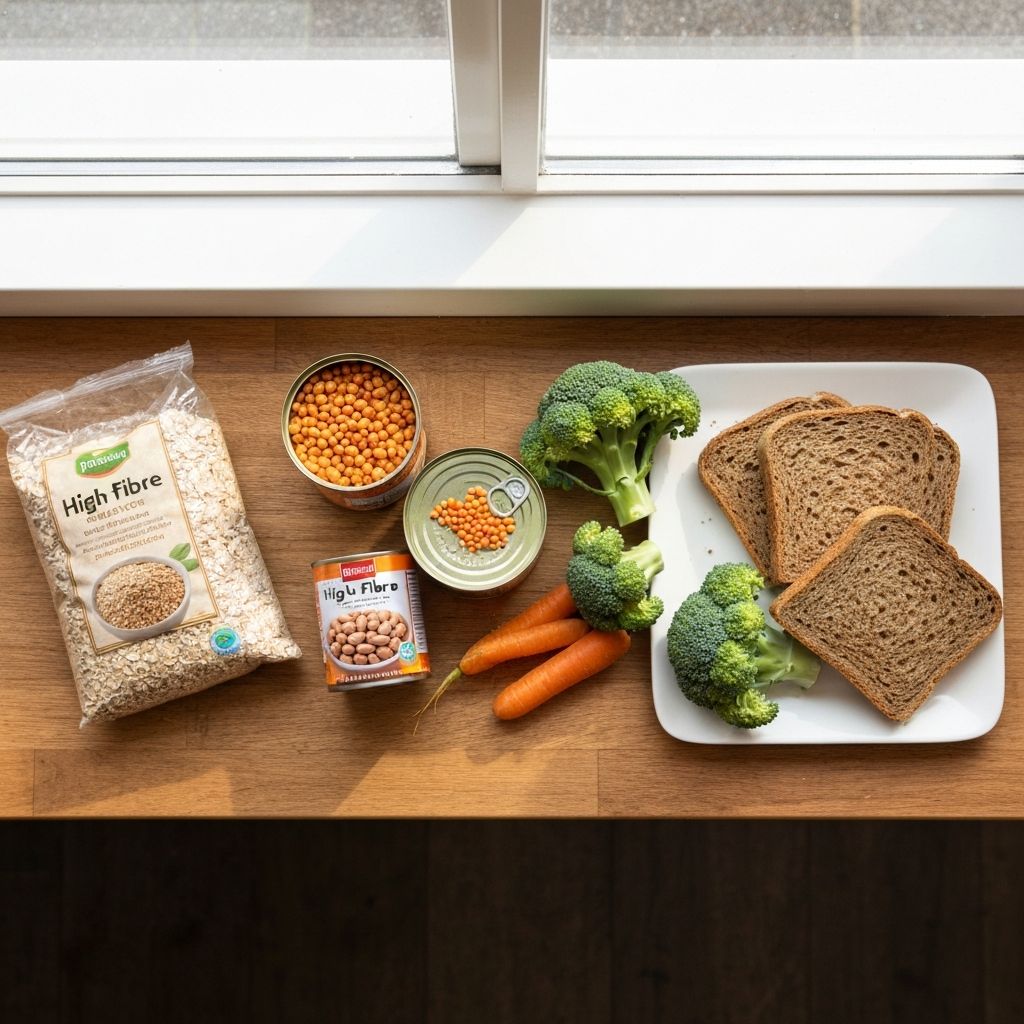
Oats
Oats are a whole grain widely available in UK supermarkets, typically sold as rolled oats or porridge oats. They contain approximately 10-11g of fibre per 100g, with approximately 389 kcal per 100g. Fibre content includes both soluble fibre (beta-glucan) and insoluble fibre.
| Nutrient | Per 100g | Per 40g serving |
|---|---|---|
| Energy | 389 kcal | 156 kcal |
| Protein | 17g | 7g |
| Carbohydrates | 66g | 26g |
| Fibre | 11g | 4.4g |
| Fat | 7g | 3g |
Lentils
Tinned lentils are shelf-stable and require no preparation, widely available in UK supermarkets. Drained tinned lentils contain approximately 3g of fibre per 100g and approximately 32 kcal per 100g. Dried lentils, when rehydrated, have similar nutritional characteristics but with different water content affecting serving size.
| Nutrient | Per 100g (tinned, drained) | Per 100g (dried) |
|---|---|---|
| Energy | 32 kcal | 353 kcal |
| Protein | 2.5g | 25g |
| Fibre | 3g | 11g |
| Carbohydrates | 5g | 63g |
Tinned Beans
Tinned beans (chickpeas, black beans, kidney beans) are shelf-stable and widely available in UK supermarkets. Drained tinned beans contain approximately 5-6g of fibre per 100g and approximately 85-100 kcal per 100g depending on the type. Salt content varies by product and brand.
| Bean Type | Fibre per 100g | Protein per 100g | Energy per 100g |
|---|---|---|---|
| Chickpeas | 5g | 7g | 85 kcal |
| Black Beans | 6g | 8g | 87 kcal |
| Kidney Beans | 6g | 9g | 100 kcal |
Wholegrain Bread
Wholegrain and wholemeal bread are commonly stocked in UK supermarkets. Typical wholemeal bread contains approximately 6-8g of fibre per 100g and approximately 215 kcal per 100g. Specific values vary by product, with some specialty breads containing additional seeds and grains.
| Bread Type | Fibre per 100g | Protein per 100g | Energy per 100g |
|---|---|---|---|
| Wholemeal | 7g | 9g | 215 kcal |
| Wholegrain with seeds | 8g | 10g | 230 kcal |
| White bread | 2g | 8g | 220 kcal |
Fibre and Satiety Context
Fibre is a carbohydrate that the human digestive system cannot fully break down. It is found primarily in plant-based foods including vegetables, fruits, grains, legumes, nuts, and seeds.
Research has examined associations between fibre content and various physiological responses, though individual responses vary widely. Factors affecting eating patterns and food choice include texture, taste, preparation convenience, and personal preference.
Water content, particle size, and the ratio of soluble to insoluble fibre all contribute to the physical properties of food. These characteristics may influence how quickly food is consumed and other eating-related factors.
Energy density—the amount of energy per unit of food weight—varies among high-fibre foods. Some high-fibre options (like nuts and oats) are more energy-dense, whilst others (like vegetables and beans) are less energy-dense.
Informational Content: The information presented here is educational and factual about food composition. Individual energy needs, food preferences, and dietary choices vary widely. This content does not provide nutritional recommendations or make claims about outcomes.
Explore Other Food Categories
Browse additional comparisons and informational guides about UK supermarket foods.
View all explorations